

Early Morning Fitness Routine Full Guide 2026
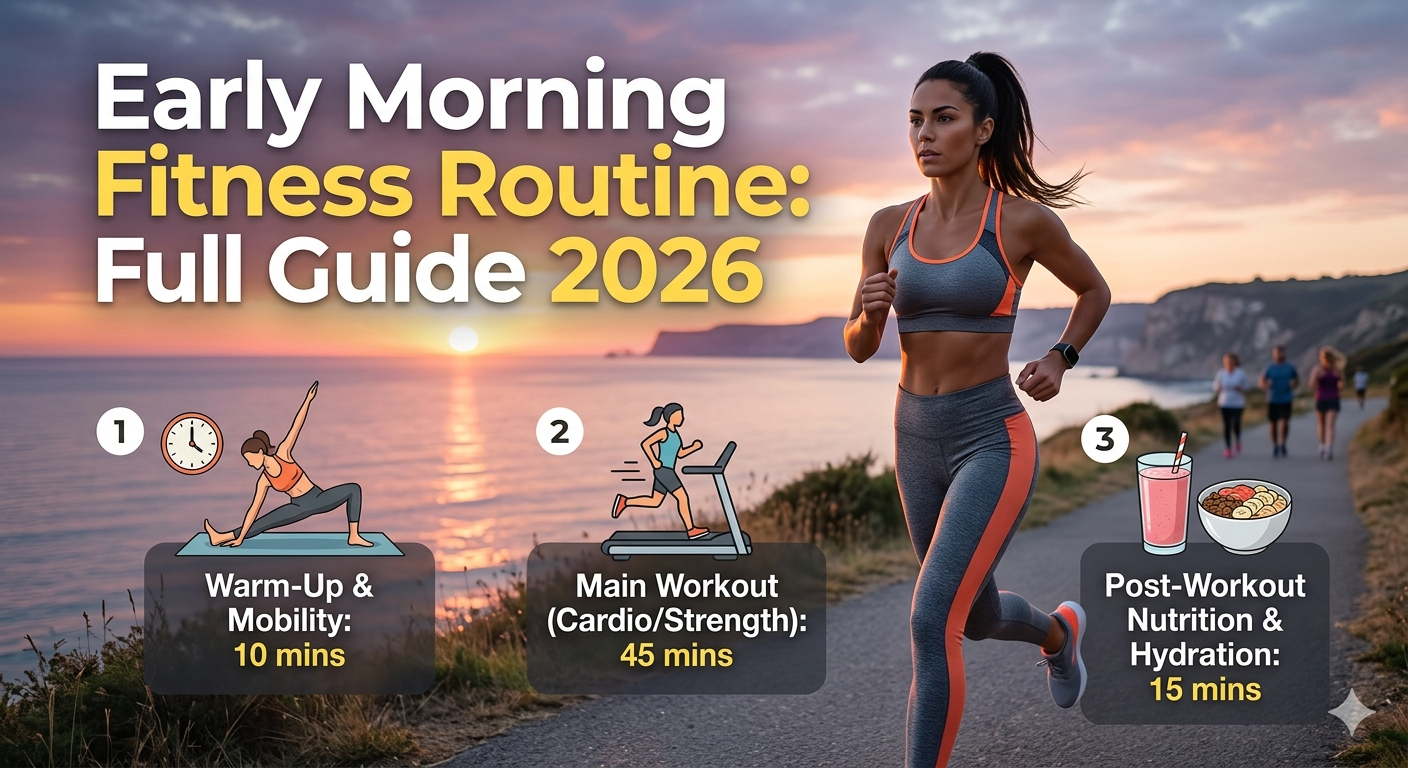
Table of Contents
The 2026 Morning Edge: More Than a Wake-Up Call
It’s 2026. The world is louder and faster than ever. If you’re waiting until 5:00 PM to find your focus, you’ve already lost the lead. The morning isn’t just a time of day; it’s a competitive cheat code.
The “Why”: Hardwiring the Win
You’re baseline-loading your dopamine. Instead of a cheap spike from a phone screen, you’re earning a steady, sustainable chemical floor for the day.
- Mental Clarity: You clear the “sleep fog” by forcing a spike in circulation.
- Cognitive Baseline: You’re setting a high bar for your focus before the first email even hits your inbox.
The Modern Shift: Recovery over Grind
Forget the old “grind until you break” 2010s mentality. The 2026 shift is about Optimized Recovery. We aren’t waking up early to suffer; we’re waking up early to win.
- Old Way: Coffee, chaos, and burnout.
- New Way: Movement, hydration, and intentionality. It’s not about how much you can endure; it’s about how quickly you can prime your system to perform at 100%.
The Hook: Look, I get it. The bed is warm. The room is cold. Your brain is telling you that ten more minutes of sleep is “self-care.” It’s a lie. The competitive advantage of owning the dawn is unmatched. While the rest of the world is hitting snooze, you’re already miles ahead.
The Night Before: Priming the Engine
If you’re waiting until your alarm goes off to decide to be great, you’re already behind. A high-performance morning is won or lost the night before. You don’t just “wake up” ready; you prime the system.
Sleep Hygiene 3.0: Data-Driven Rest
In 2026, “getting eight hours” is amateur hour. We’re looking at biometric precision.
The Sleep Window: Use your wearable data to identify your optimal recovery window. If your HRV (Heart Rate Variability) is tanking, you shift your window.
- The Goal: Consistency isn’t about the clock; it’s about hitting your deep sleep cycles so you wake up with a “ready-to-perform” score, not a “survival” score.
Friction Reduction: The 2026 Setup
Willpower is a finite resource—don’t waste it at 5:00 AM. You need to automate the “start” button.
- The Classics: Lay out the kit. Shoes, shorts, and tech are staged and ready.
- The Digital Prep: If your home is smart, use it. Pre-set your gym temperature to 65°F (18°C) for optimal output.
- The AI Edge: Your agent has already analyzed your sleep cycles and adjusted your lifting percentages before you even lace up.
The Hydration Strategy: The Real Energy Secret
Forget the “pre-workout” powders for a second. The real secret to 2026 energy is Fluid Intelligence.
- The Pre-Load: Drink 16oz of water 30 minutes before bed. You’re prepping your cells for the overnight fast.
- The Wake-Up Flush: The second you hit the floor, you hydrate. You aren’t “tired” in the morning; you’re dehydrated. Water hits the “on” switch for your metabolism and brain function faster than caffeine ever will.
The Launch Sequence (0–30 Minutes)
The first half-hour of your day is the critical window. This isn’t just about waking up; it’s about a deliberate “system-on” sequence. You don’t let the day happen to you—you happen to the day.
The No-Snooze Rule: Beating the Inner Negotiator
The second you hit snooze, you’ve already negotiated with your goals. In 2026, we’ve moved past “willpower” and into tactical positioning.
- The 5-Second Rule: Use the “5-4-3-2-1” countdown. When you hit one, you move. No thinking, just execution.
- The Physics of Waking: Get your phone or alarm out of reach. Making yourself physically stand up and walk across the room breaks the sleep inertia and ends the negotiation before it starts.
Light Exposure: Resetting the Clock
Your body doesn’t just “know” it’s morning; it reacts to environmental triggers. * Natural Sunlight: If the sun is up, get your eyes on it for 5–10 minutes. It’s the fastest way to suppress melatonin and trigger your natural cortisol spike.
- High-Lux Artificial Light: It’s 2026—if you’re waking up before the sun, use a 10,000-lux SAD lamp or smart-lighting to simulate dawn. You’re manually resetting your circadian rhythm for peak energy 12 hours from now.
Micro-Movements: Waking Up the Joints
Before you hit the heavy weights or the high-intensity intervals, you need to prime the “chassis.”
- The 5-Minute Dynamic Flow: We aren’t looking for a “sweat” yet; we’re looking for joint lubrication. * The Sequence: Think cat-cow stretches, world’s greatest stretch, and hip openers. You’re telling your nervous system that it’s safe to produce power. By the time the real workout begins, your body is already online and injury-resistant.
2026 Training Trends: What’s Working Now
If you’re still training like it’s 2020, you’re leaving gains on the table. The “Workout Haven” standard for 2026 is about Maximum ROI. We don’t just work hard; we work smart.
Hybrid Efficiency: The “Time-Crunched” Revolution
Stop choosing between being “strong” and being “fit.” In 2026, we are all Hybrid Athletes. * The Method: We’re stacking Zone 2 cardio (that steady-state, conversational pace) directly with functional strength.
- The Session: Imagine 20 minutes of steady rowing or incline walking followed immediately by a heavy functional circuit. You’re building an engine that has both the horsepower for a heavy squat and the fuel tank for a 10k. It’s the ultimate 45-minute solution for the busy professional.
AI-Adjusted Intensity: Training by the Numbers
Gone are the days of “forcing” a PR when your body is screaming for rest. We now use Autoregulation.
- The Biometric Edge: Your wearable tells the story. If your HRV (Heart Rate Variability) is high, the AI gives you the “Green Light”—that’s your day to chase a New Personal Record.
- The Pivot: If your recovery score is tanking, the system automatically swaps your heavy lifting for a “Mobility & Flow” session. You aren’t being lazy; you’re being calculated. You prevent the injury before it happens.
The Gamification Factor: 5:00 AM in Meta
Let’s be real—the treadmill can be a soul-sucking void. That’s why 2026 is the year of Immersive Fitness.
- VR & AR Integration: Why stare at a wall when you can be shadowboxing in a neon-drenched cyberpunk arena or racing a virtual peloton through the Swiss Alps?
- The Engagement Hack: By turning your 5:00 AM sweat into a game with real-time leaderboards and “level-up” mechanics, the friction of waking up disappears. You aren’t “exercising”; you’re playing—and winning.
Fueling the Fire: Nutrition & Supplementation
You can’t drive a Ferrari on low-grade fuel. If you want to own the morning and dominate the workday, your nutrition has to be as precise as your training.
To Fast or Not to Fast? The 2026 Consensus
The “fasted cardio” debate has finally been settled with context. * The Protein-Sparing Shift: In 2026, we’ve realized that pure fasting during high-intensity sessions can lead to muscle wastage.
- The Strategic Choice: If it’s a low-intensity Zone 2 walk, stay fasted. But if you’re hitting the weights or a high-intensity circuit, we’re moving toward Protein-Sparing Modified Mornings. A small hit of essential amino acids (EAAs) or a collagen shot keeps your muscle tissue protected without the heavy “digestion fog.”
The Morning Stack: Quick-Digesting Power
Forget the heavy pancakes. We need Immediate Bioavailability.
- Electrolytes: The first thing you lose overnight is minerals. A high-quality electrolyte stack (Sodium, Potassium, Magnesium) is non-negotiable for nerve conduction and muscle contraction.
- The Simple Carb Hack: A single piece of fruit—like a banana or a handful of berries—provides just enough glucose to spike your performance without the insulin crash 60 minutes later.
Post-Workout Synergy: Sustaining the Momentum
The “anabolic window” isn’t just about gains; it’s about mental stability.
- The Protein Window: Getting 30-40g of high-quality protein within 60 minutes of finishing your session is the key to stopping the cortisol spike in its tracks.
- The Workday Edge: By stabilizing your blood sugar immediately after your workout, you avoid the 10:00 AM energy dip. You transition from the “Athlete” mindset to the “Professional” mindset with zero friction.
Recovery & Transition: From Gym to Desk
The workout is over, but the mission isn’t. Most people crash or lose momentum during the “shower and commute” phase. In 2026, we will use specific protocols to channel that physical energy into cognitive dominance.
Contrast Therapy: The Ultimate Morning Finisher
The “Cold Plunge” has moved from a niche biohack to a standard morning requirement.
- The Cold Shock: Ending your shower with 2–3 minutes of freezing water isn’t just about “grit.” It triggers a massive release of norepinephrine, keeping your focus dialed in for hours.
- The Recovery Edge: It flushes the lymphatic system and reduces systemic inflammation, ensuring you arrive at your desk feeling light and agile, not stiff and sluggish.
The “Deep Work” Bridge: Leveraging the Endorphin High
You are never more mentally sharp than the 60 minutes following a workout. This is your Biological Power Hour.
- The Strategy: Do not waste this window on emails or “busy work.” Use the post-workout dopamine and endorphin rush to tackle your hardest, most creative task of the day.
- The Result: Because your “inner critic” was silenced during the workout, you’ll find you can enter a flow state much faster.
Mental Cool-down: Closing the Loop
Before you open your laptop, you need to down-regulate your nervous system. You’ve been in “Fight or Flight” mode; now you need “Focus” mode.
- The 5-Minute Reset: Use a guided box-breathing technique or a simple mindfulness meditation.
- The Goal: You’re telling your brain that the physical stress is over and the intellectual mission has begun. This prevents “carry-over stress” and keeps you calm under the pressure of the workday.
Conclusion: Consistency Over Intensity
In 2026, the real “elite” aren’t the ones who go the hardest once a week—they are the ones who never miss. You don’t need to be perfect; you just need to be present.
The 80% Rule: Ending the All-or-Nothing Trap
We’ve all seen the burnout cycle: a “perfect” week of 4:00 AM wake-ups followed by a total collapse. At The Workout Haven, we play the long game.
- The Math of Success: Showing up at 80% intensity 5 days a week will always outperform 110% intensity for 2 days followed by a week on the couch.
- The Grace Period: If the “bed is too warm” one morning, don’t throw the whole week away. Reset, recalibrate, and get back on the sequence tomorrow. Your results are a lagging indicator of your habits, not a single workout.
Take Action: Start the Sequence
Knowledge without action is just noise. You’ve read the 2026 Morning Edge—now it’s time to sharpen yours.
- The Challenge: Don’t try to overhaul all six sections at once. Pick one habit from this guide—whether it’s the No-Snooze Rule, the Hydration Strategy, or the Light Exposure—and implement it tomorrow morning.
Frequently Asked Questions (FAQ)
Q: Is it better to workout before or after breakfast?
A: In 2026, the consensus is personalization via biometrics. If your goal is fat oxidation, “fasted” workouts can be effective, provided your intensity stays moderate. However, for high-intensity interval training (HIIT) or heavy lifting, a small protein-carb “micro-snack” 30 minutes prior usually yields better performance data.
Q: How do I handle “low recovery” scores on my wearable?
A: Don’t ignore the data, but don’t let it be an excuse to sleep in. If your smart ring or watch shows a low recovery score, pivot to a “Low-Impact Mobility” session or a long walk. Consistency is about the habit of movement, not always the intensity.
Q: What is the shortest effective morning workout?
A: Research now supports “Exercise Snacking.” Even a 12-minute high-intensity functional circuit can trigger significant metabolic benefits and mental clarity if you are consistent. Quality of movement beats quantity of time.
Q: How can I stop hitting the snooze button?
A: Use the “Distance Method”—place your alarm (or phone) in another room so you are forced to stand up. Additionally, consider “Smart Blinds” that sync with your alarm to flood the room with light, naturally suppressing melatonin production.
Q: Does coffee count as pre-workout hydration?
A: Caffeine is a fantastic ergogenic aid, but it’s a diuretic. For every cup of coffee, match it with 250ml of water plus electrolytes to ensure your muscles are hydrated enough to contract efficiently.
Faisal is the founder and content creator of The Workout Haven, a fitness and wellness blog focused on home workouts, weight loss, strength training, yoga, and healthy lifestyle habits. He creates easy-to-follow, beginner-friendly fitness guides backed by research, practical experience, and real-world application. Faisal’s goal is to help people stay active, build strength, and improve overall health—no gym or expensive equipment required.